
Laser Skin Resurfacing in Islamabad
Laser Skin Resurfacing is an aesthetic skin treatment that uses controlled laser energy to improve selected concerns such as fine lines, sun damage, uneven texture, age spots and certain acne scars. Depending on the technology, the laser may remove microscopic portions of damaged surface skin, heat deeper tissue to stimulate collagen remodelling, or combine both effects.
Laser resurfacing ranges from relatively gentle non-ablative fractional treatments with limited downtime to more intensive ablative CO2 or Er resurfacing that produces greater skin injury and a longer recovery period. The correct laser, depth and energy settings should be selected according to the patient's skin tone, concern and tolerance for downtime because overly aggressive treatment can cause burns, prolonged redness, pigmentation changes, infection or scarring.
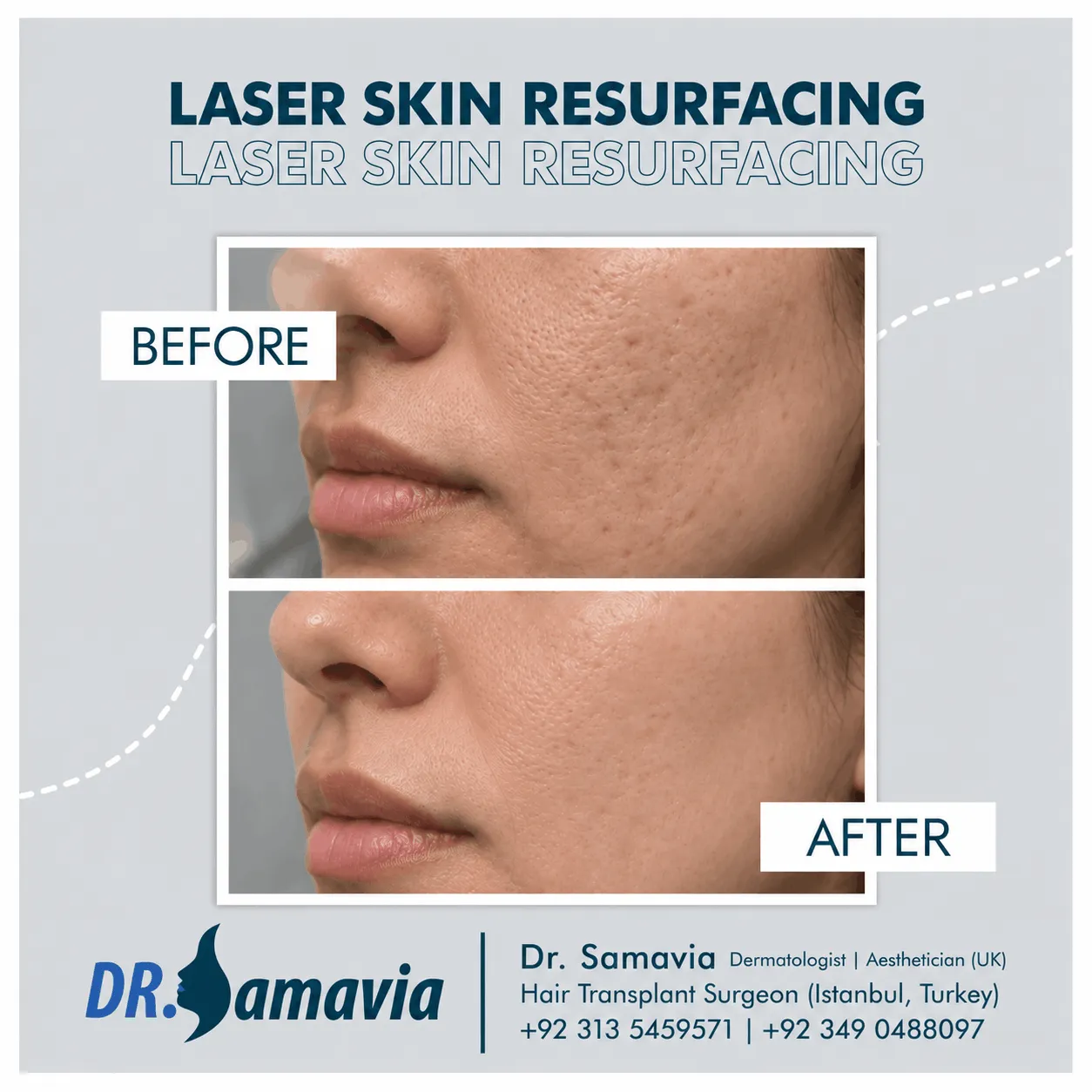
What is Laser Skin Resurfacing?
Laser Skin Resurfacing uses concentrated light energy to create controlled treatment within the skin.
Depending on the laser, treatment may affect:
- Epidermis
- Dermis
- Pigment
- Water within skin tissue
- Collagen-containing structures
The purpose is to remove or remodel selected damaged tissue and trigger controlled healing.
Ablative laser resurfacing removes portions of the epidermis while heating the underlying dermis. This stimulates wound healing and collagen production as new surface skin develops.
Non-ablative treatments leave the outer skin largely intact while delivering controlled thermal energy deeper within the skin.
Fractional Laser Technology
Both ablative and non-ablative lasers can be delivered fractionally.
Fractional treatment creates microscopic columns of treated skin separated by areas of relatively untreated tissue.
This allows:
- Faster healing than traditional full-field resurfacing
- Reduced downtime
- Lower complication risk in many protocols
- Gradual collagen remodelling
Mayo Clinic notes that fractional techniques can reduce recovery time and side-effect risk compared with treating the entire skin surface, although multiple sessions are often required.
What Is Laser Skin Resurfacing Used For?
Laser Skin Resurfacing may be considered for:
- Fine facial lines
- Selected wrinkles
- Sun-damaged skin
- Rough skin texture
- Uneven skin tone
- Age spots
- Selected superficial pigmentation
- Mild-to-moderate acne scars
- Certain traumatic or surgical scars
- Selected enlarged pores
- General photoageing
Mayo Clinic lists fine wrinkles, age spots, uneven colour or texture, sun-damaged skin and mild-to-moderate acne scars among established uses of laser resurfacing.
The American Society of Plastic Surgeons also describes resurfacing as a treatment for facial wrinkles, scars and selected blemishes.
A Personalized Approach to Laser Skin Resurfacing
Skin ageing, acne scars, pigmentation and textural concerns vary considerably between patients, so Laser Skin Resurfacing should be planned according to the individual's skin type, treatment concern, scar pattern, pigmentation tendency and acceptable recovery period rather than using the same laser or treatment intensity for everyone.
Before recommending Laser Skin Resurfacing, Dr. Samavia assesses each patient individually, considering skin tone and Fitzpatrick skin type, the type and severity of scarring or texture changes, pigmentation concerns, degree of sun damage, active acne, previous aesthetic treatments, history of abnormal scarring or cold sores, current medications, medical history and the patient's expectations.
The first priority is to identify exactly what needs to be treated. Fine lines, photoageing, superficial pigmentation, rough texture and different types of acne scars can require very different approaches. For example, rolling, boxcar and ice-pick acne scars do not respond identically, and some patients may benefit more from combination treatment than from laser resurfacing alone.
If Laser Skin Resurfacing is considered appropriate, Dr. Samavia develops an individual treatment plan that may involve fractional CO2 laser, erbium-based resurfacing, non-ablative fractional laser or another appropriately selected technology, depending on the patient's skin characteristics and treatment goals.
Treatment intensity is also personalised. A patient seeking mild improvement with limited downtime may be more suited to a gentler fractional or non-ablative approach, while selected patients requiring stronger resurfacing may be considered for a more intensive ablative treatment with a longer recovery period and greater potential risk.
Particular caution is required in patients with medium-to-dark skin tones or a history of post-inflammatory hyperpigmentation, because aggressive laser treatment can increase the risk of prolonged darkening, lightening, burns or other pigment changes. In these patients, Dr. Samavia may use more conservative parameters, different technology, appropriate skin preparation or consider an alternative treatment when it offers a better risk-benefit balance.
Depending on the diagnosis, an individual rejuvenation or scar-treatment plan may also include medical-grade skincare, microneedling, RF microneedling, chemical peels, subcision, TCA CROSS, dermal fillers or other clinically appropriate procedures. Not every patient requires the same combination of treatments.
Patients should understand that Laser Skin Resurfacing can improve scars, texture, fine lines and selected pigmentation, but it cannot guarantee perfect skin, complete scar removal, permanent pore elimination or identical results in every skin type.
Monitoring Healing and Treatment Progress
Recovery and treatment monitoring depend significantly on whether the procedure is ablative or non-ablative.
After gentler non-ablative treatment, redness, warmth or mild swelling may settle relatively quickly. More intensive ablative resurfacing can produce considerably greater redness, swelling, peeling, crusting and wound-care requirements during the healing period.
Dr. Samavia reviews treatment progress where appropriate, assessing skin healing, pigmentation, redness, texture, scar appearance and any signs of delayed healing, infection or other complications.
Where useful, standardised baseline and follow-up clinical photographs may be used to document the patient's starting condition and objectively compare changes over time.
Patients should also understand that collagen remodelling continues after the skin surface has healed. Final improvement should therefore not be judged immediately after treatment, as changes in texture and scar appearance can continue to develop over several weeks or months.
The need for additional sessions is determined according to the laser technology used, treatment intensity, clinical response, healing pattern and treatment goal rather than a guaranteed fixed number of procedures.
Personalised aftercare is particularly important following resurfacing. Patients receive guidance regarding cleansing, moisturising, wound care, active skincare products, sun exposure and warning symptoms. Strict sun protection is especially important because recently treated skin may remain vulnerable to pigmentation changes for an extended period.
If you are considering Laser Skin Resurfacing in Islamabad, you can book a consultation with Dr. Samavia for an individual skin assessment and personalised resurfacing treatment plan.
What concerns can it address?
Fine Lines and Wrinkles
Laser resurfacing can improve selected superficial lines by:
- Removing damaged surface skin
- Stimulating collagen
- Remodelling dermal tissue
- Creating a smoother surface
It is particularly useful for textural and photoageing-related lines.
Deep expression lines may require combination treatment with other procedures.
Acne Scars
Fractional laser resurfacing may improve selected depressed acne scars by stimulating collagen remodelling.
However, acne scars differ.
They may include:
- Ice-pick scars
- Boxcar scars
- Rolling scars
- Raised scars
Different scar types respond to different treatments.
Some patients may require combinations including:
- Subcision
- Microneedling
- RF microneedling
- TCA CROSS
- Dermal fillers
- Laser resurfacing
Laser treatment can make scars less noticeable but cannot guarantee complete scar removal. The AAD specifically cautions that laser treatment improves scars rather than eliminating them completely.
Sun Damage
Laser resurfacing can improve selected signs of photodamage, including:
- Roughness
- Fine lines
- Uneven texture
- Selected pigmentation
Daily sun protection remains essential because new ultraviolet damage can reverse some benefits.
Uneven Skin Texture
Fractional resurfacing can create controlled microscopic treatment zones that encourage more uniform healing and collagen remodelling.
This can improve selected roughness and superficial irregularities.
Age Spots and Pigmentation
Certain resurfacing lasers may reduce superficial areas of excess pigment.
However, not every pigmentation disorder should be treated with resurfacing.
Melasma, in particular, can relapse or worsen after inappropriate heat or laser exposure.
Mild Skin Laxity
Collagen remodelling after laser treatment may create some tightening.
The AAD describes laser resurfacing as one of the stronger non-surgical approaches for skin tightening, but it involves more downtime and greater risk than gentler non-invasive tightening procedures.
Laser resurfacing cannot remove substantial hanging or excess skin.
Types of Laser Skin Resurfacing
Ablative CO2 Laser
Carbon dioxide (CO2) laser resurfacing is an ablative treatment that removes microscopic or continuous portions of skin while producing thermal effects in deeper tissue.
Fractional CO2 laser is widely used for concerns including:
- Acne scars
- Fine lines
- Wrinkles
- Sun damage
- Textural irregularity
It can produce substantial resurfacing but also has greater downtime and a greater risk of:
- Prolonged redness
- Hyperpigmentation
- Hypopigmentation
- Infection
- Scarring
than gentler non-ablative procedures.
Er Laser
Erbium laser is another resurfacing technology.
It can be used for superficial to moderately deep resurfacing.
ASPS describes erbium resurfacing as suitable for selected superficial and moderately deep lines and wrinkles and notes that it can be used on areas such as the face, neck, chest or hands.
Non-Ablative Fractional Laser
Non-ablative fractional laser delivers controlled heat into microscopic treatment zones without intentionally removing the entire surface layer.
Advantages may include:
- Less downtime
- Reduced surface injury
- Gradual results
- Lower complication risk than aggressive ablative resurfacing in appropriate patients
The trade-off is that results are generally more subtle and several sessions may be required.
Potential benefits
Depending on the laser and indication, potential benefits include:
- Smoother skin texture
- Improvement in fine lines
- Reduction of selected wrinkles
- Improvement in acne scars
- Reduction of selected sun damage
- Improvement in selected age spots
- More even-looking skin
- Collagen remodelling
- Mild skin tightening
- Customisable treatment depth
- Fractional options can reduce downtime compared with traditional full-field resurfacing
Laser resurfacing can provide greater correction than very superficial treatments such as:
- Hydrafacial
- Dermaplaning
- Basic facial treatments
but increased effectiveness can also mean increased recovery and risk.
Limitations and realistic expectations
Laser Skin Resurfacing cannot guarantee:
- Perfect skin
- Complete scar removal
- Permanent pore elimination
- Removal of every wrinkle
- Permanent pigmentation removal
- Surgical lifting
- Zero downtime
- Scar-free treatment
- Identical results for every skin tone
Results depend on:
- Laser wavelength
- Ablative versus non-ablative treatment
- Fractional versus full-field treatment
- Energy settings
- Number of sessions
- Skin tone
- Scar type
- Age
- Sun damage
- Healing response
- Practitioner experience
Normal skin ageing also continues.
ASPS notes that improvements may continue for many months and can last for years, but wrinkles and expression lines can eventually recur as ageing continues.
Patients should be cautious about claims such as:
- “100% scar removal”
- “Permanent glass skin”
- “Zero risk of pigmentation”
- “One laser works for every skin colour”
- “No downtime CO2 laser”
- “Permanent facelift without surgery”
These claims are not realistic.
Laser Skin Resurfacing for Acne Scars
Laser treatment can be useful for selected depressed acne scars, but scar classification is essential.
Rolling Scars
Rolling scars can be associated with fibrous attachments beneath the skin.
Subcision may sometimes be required before or alongside resurfacing.
Boxcar Scars
Fractional resurfacing may help selected shallow or moderately deep boxcar scars.
Ice-Pick Scars
Deep narrow ice-pick scars may respond poorly to resurfacing alone.
Treatment may require:
- TCA CROSS
- Punch techniques
- Combination scar therapy
Raised Scars
Raised hypertrophic or keloid scars require a different approach.
The AAD notes that lasers can help selected raised and depressed scars, but treatment should be tailored to the scar type.
Active acne should generally be controlled before intensive acne-scar resurfacing to reduce the formation of new scars.
Laser Skin Resurfacing and Darker Skin Tones
Laser resurfacing can be performed in patients with a range of skin tones, but darker skin requires additional caution.
Skin containing more melanin has an increased risk of:
- Post-inflammatory hyperpigmentation
- Hypopigmentation
- Burns
- Prolonged pigment changes
The AAD states that lasers can be used in all skin types but warns that darker skin is more prone to burns and post-treatment dark marks, making experience with darker skin especially important.
Mayo Clinic similarly states that people with brown or Black skin have a higher risk of longer-lasting colour changes after laser resurfacing.
This does not mean darker skin can never receive laser treatment.
Instead, treatment may require:
- More conservative parameters
- Different wavelengths
- Fractional approaches
- Appropriate pre-treatment skincare
- Strict sun protection
- Longer intervals between treatments
- Consideration of alternative treatments
In selected patients, alternatives such as RF microneedling may have a lower risk of pigmentation change.
Who may be suitable?
Laser Skin Resurfacing may be considered for adults with:
- Fine lines
- Photoageing
- Uneven skin texture
- Selected age spots
- Mild-to-moderate acne scars
- Selected facial scars
- Mild skin laxity
- Realistic expectations
A consultation should assess:
- Skin tone
- Fitzpatrick skin type
- Primary concern
- Scar type
- Pigmentation tendency
- Sun exposure
- Previous laser treatment
- Active acne
- History of cold sores
- Abnormal scarring
- Current medication
- Medical conditions
The intensity of treatment should match the patient's goals and tolerance for downtime.
Who may not be suitable?
Laser resurfacing may need to be postponed, modified or avoided in patients with:
- Active skin infection
- Active herpes outbreak
- Open wounds
- Significant active acne
- Severe inflammatory skin disease
- Recent significant tanning
- Sunburn
- Poor wound healing
- Certain immune disorders
- Significant tendency toward keloid scarring
- Unrealistic expectations
Mayo Clinic identifies additional situations requiring caution, including certain autoimmune or connective-tissue disorders, prior facial radiation, history of abnormal scarring and other factors that can affect healing.
Isotretinoin history
Previous or current isotretinoin use should always be disclosed.
The appropriate interval between isotretinoin treatment and specific laser procedures is an evolving area and depends on the resurfacing method, dose and individual risk.
A fixed rule should not be applied without clinical assessment.
Pregnancy and breastfeeding
Elective laser resurfacing is generally deferred during pregnancy.
Breastfeeding status should also be discussed when medications, topical anaesthetic or other adjunctive treatment may be required.
How to prepare
Before Laser Skin Resurfacing, tell your clinician about:
- Prescription medications
- Isotretinoin
- Retinoids
- Blood-thinning medicines
- Photosensitising medication
- Supplements
- Previous laser procedures
- Chemical peels
- Microneedling
- Dermal fillers
- Botox
- History of cold sores
- Keloid scarring
- Pigmentation problems
- Autoimmune conditions
- Recent tanning
- Pregnancy or breastfeeding
Avoid tanning
Sun exposure before resurfacing can increase the risk of pigmentation complications.
Mayo Clinic recommends avoiding unprotected sun exposure before treatment and discussing an appropriate sun-protection plan with the treating clinician.
Antiviral medication
Patients with a history of cold sores may be prescribed antiviral medication before and after facial resurfacing to reduce herpes reactivation risk.
Smoking
Smoking can impair healing.
Mayo Clinic advises stopping or avoiding smoking before and after treatment to reduce healing complications.
Skincare preparation
Some patients may be given a pre-treatment skincare programme.
Strong retinoids, exfoliating acids or other irritating products may need to be temporarily adjusted.
Do not stop prescribed medication without medical advice.
How the procedure works
1. Skin assessment
The clinician assesses:
- Skin type
- Pigmentation
- Texture
- Scarring
- Wrinkles
- Treatment goals
2. Laser selection
The treatment may involve:
- Fractional CO2
- Er
- Non-ablative fractional laser
- Another appropriately selected laser system
3. Skin preparation
The skin is thoroughly cleansed.
Protective eyewear is essential.
4. Anaesthesia
Depending on treatment intensity, pain control can include:
- Topical anaesthetic
- Local anaesthetic
- Cooling
- Sedation for selected extensive procedures
ASPS notes that laser resurfacing can be uncomfortable and that local anaesthesia, sedation or, in extensive cases, other anaesthetic approaches may be used.
5. Laser delivery
Controlled pulses are passed across the treatment area.
In ablative resurfacing, the laser removes microscopic portions of damaged epidermis while heating deeper dermal tissue.
In non-ablative fractional treatment, controlled thermal columns are created while much of the skin surface remains intact.
6. Cooling and wound care
After treatment, soothing products, ointment or dressings may be applied depending on the procedure.
7. Aftercare instructions
The patient receives specific advice regarding:
- Cleansing
- Moisturising
- Wound care
- Sun protection
- Makeup
- Active skincare
- Warning symptoms
Results and treatment timeline
The timeline varies greatly between treatment types.
Non-Ablative Fractional Laser
Immediately after treatment there may be:
- Redness
- Mild swelling
- Warmth
These effects may settle within hours to several days.
Results develop gradually as collagen remodels.
Multiple sessions are commonly required.
Ablative Laser
Immediately after treatment, the skin may be:
- Red
- Swollen
- Tender
- Raw
- Oozing
- Crusted
depending on treatment depth.
Mayo Clinic states that new skin commonly covers an ablatively resurfaced area in approximately 7 to 10 days, while complete recovery takes longer.
ASPS gives broad recovery estimates of approximately:
- Up to 2 weeks for CO2 resurfacing
- Around 1 week for erbium resurfacing
although individual recovery varies considerably.
Following several weeks
The skin gradually becomes:
- Smoother
- More even in texture
- Less rough
- Less visibly scarred in responding areas
Several months
Collagen remodelling continues.
Improvement may therefore continue after the surface has healed.
ASPS notes that laser-resurfacing results may continue to improve for up to a year.
Risks and side effects
Laser resurfacing is a medical procedure and complications are possible.
Common temporary effects can include:
- Redness
- Swelling
- Burning
- Stinging
- Itching
- Tenderness
- Dryness
- Peeling
More significant risks include:
Hyperpigmentation
Treated skin may become darker.
This is particularly important in patients with medium-to-dark skin tones.
Hypopigmentation
The treated area can become lighter than the surrounding skin.
Persistent hypopigmentation can be difficult to correct.
Burns
Excessive laser energy can create unintended thermal injury.
Infection
Possible infections include:
- Bacterial infection
- Viral infection
- Fungal infection
Herpes simplex reactivation is an important consideration after facial resurfacing.
Scarring
Scarring is uncommon but possible and is more strongly associated with deeper or complicated resurfacing.
Acne and Milia
Occlusive healing ointments and the healing process can sometimes trigger:
- Acne breakouts
- Small white milia
Prolonged Redness
Redness can persist for weeks or months after intensive ablative resurfacing.
ASPS notes that pinkness may gradually fade over two to three months and can occasionally persist substantially longer.
Delayed Healing
Certain medical conditions, medications, smoking and excessive treatment intensity can interfere with wound healing.
ASPS lists burns, scarring, delayed wound healing, infection and pigmentation irregularities among recognised resurfacing risks.
Recovery and aftercare
Aftercare is essential following Laser Skin Resurfacing.
Instructions depend on whether treatment was ablative or non-ablative.
After Non-Ablative Treatment
Patients may usually:
- Return to routine activities relatively quickly
- Use cooling if advised
- Apply gentle moisturiser
- Use sunscreen consistently
- Avoid irritating skincare temporarily
After Ablative Resurfacing
More intensive wound care may be required.
Patients may be advised to:
- Clean the skin exactly as instructed.
- Apply prescribed protective ointment.
- Keep healing skin appropriately moisturised.
- Avoid picking crusts or peeling skin.
- Avoid aggressive skincare.
- Avoid swimming until healing is adequate.
- Avoid excessive heat.
- Avoid unnecessary sun exposure.
- Attend follow-up appointments.
ASPS specifically advises against scratching or picking crusts because this can increase scarring risk.
Sun Protection
Sun protection is one of the most important parts of recovery.
Use:
- Broad-spectrum sunscreen
- SPF 30 or higher
- Protective clothing
- Shade
according to clinician instructions.
Treated skin may remain especially sun-sensitive for months.
Contact the clinic if you develop:
- Increasing severe pain
- Significant blistering
- Pus or discharge
- Fever
- Spreading redness
- Significant facial swelling
- Persistent abnormal darkening
- Persistent whitening
- Delayed wound healing
- Another unexpected reaction
Alternatives and comparisons
The best alternative depends on the patient's main concern.
Options may include:
- Chemical peels
- Microneedling
- RF microneedling
- Dermabrasion
- IPL for selected pigmentation or vascular concerns
- Medical skincare
- Botox
- Dermal fillers
- Subcision
- TCA CROSS
- Surgical procedures for significant laxity
Laser Resurfacing vs Microneedling
Microneedling creates mechanical micro-injuries with needles.
Laser resurfacing creates controlled light-based thermal or ablative injury.
Laser treatment can provide stronger resurfacing in selected patients but may involve:
- More downtime
- Greater heat
- Higher pigment risk
particularly with aggressive ablative treatment.
Microneedling may be considered when a lower risk of pigment alteration is desirable.
Laser Resurfacing vs RF Microneedling
RF microneedling delivers radiofrequency energy through needles into selected tissue depths.
Because the energy is delivered beneath much of the surface epidermis, it can be useful for selected patients at greater risk of laser-related pigmentation changes.
The best option depends on scar type, skin tone and treatment goals.
Laser Resurfacing vs Chemical Peel
Chemical peels create controlled chemical injury.
Laser resurfacing uses light energy and generally allows more precise control of treatment depth depending on the device.
Both procedures can cause:
- Redness
- Pigmentation changes
- Infection
- Scarring
when performed too aggressively.
Ablative vs Non-Ablative Laser
Ablative laser:
- Removes portions of skin
- Usually stronger results
- More downtime
- Greater complication risk
Non-ablative laser:
- Heats deeper tissue while largely preserving the surface
- Less downtime
- More gradual improvement
- Usually requires more sessions
Mayo Clinic states that non-ablative treatments are less aggressive with shorter recovery, while ablative resurfacing generally produces stronger correction.
Laser Resurfacing vs Hydrafacial
Hydrafacial provides superficial:
- Cleansing
- Exfoliation
- Extraction
- Hydration
Laser resurfacing creates controlled tissue injury and collagen remodelling.
Hydrafacial therefore cannot provide the same correction for acne scars or photoageing as an appropriately selected resurfacing laser.
What affects the cost?
The cost of Laser Skin Resurfacing depends on:
- Laser technology
- Ablative versus non-ablative treatment
- Fractional versus full-field resurfacing
- Size of treatment area
- Full face versus selected areas
- Acne-scar severity
- Treatment depth
- Number of sessions
- Anaesthesia requirements
- Combination treatments
- Practitioner expertise
- Follow-up and wound care
A light fractional treatment of a small area has a very different cost and recovery profile from aggressive full-face fractional CO2 resurfacing.
Patients should therefore ask for the exact laser technology and treatment intensity when comparing prices.
Terms such as:
- “Fractional laser”
- “CO2 laser”
- “Skin laser”
- “Resurfacing laser”
are not interchangeable descriptions of the same procedure.
The treatment should be selected according to:
- Diagnosis
- Skin tone
- Scar type
- Desired improvement
- Acceptable downtime
- Pigmentation risk
rather than simply choosing the strongest laser available.
Patient experiences
Reviews describe individual experiences and do not predict another patient's result.
I had a wonderful experience consulting with Dr. Samaviya Ejaz. She is an incredibly impressive and professional dermatologist. Her clinic is beautiful and has a calming atmosphere.
Umar Shah
Read on GoogleI had my hair fall consultation with Dr Samavia. She thoroughly explained the treatment. After PRF sessions my hair fall stopped and density improved. Highly recommend.
Moneeb Mumtaz
Read on GoogleI have had a few treatments at this clinic and I am happy with the outcomes. Dr. Samavia and her team are kind, professional, and trustworthy.
Sheikh Yousuf Kareem
Read on GoogleVisit Dr Samavia at Facetime Clinic
Use the verified Google profile for clinic directions, business details and linked patient reviews.
Clinical references
- Laser ResurfacingMayo Clinic · accessed 4 September 2026
- Laser Skin ResurfacingAmerican Society of Plastic Surgeons · accessed 4 September 2026
- Laser Skin Resurfacing: RecoveryAmerican Society of Plastic Surgeons · accessed 4 September 2026
- Skin Rejuvenation and Resurfacing: Risks and SafetyAmerican Society of Plastic Surgeons · accessed 4 September 2026
- Skin Conditions That Lasers Can TreatAmerican Academy of Dermatology · accessed 4 September 2026
- 10 Things to Know Before Having Laser Treatment for Your ScarAmerican Academy of Dermatology · accessed 4 September 2026
- Aesthetic (Cosmetic) DevicesU.S. Food and Drug Administration · accessed 4 September 2026
Laser Skin Resurfacing FAQs
What does Laser Skin Resurfacing treat?
Laser Skin Resurfacing can improve selected fine lines, sun damage, uneven skin texture, age spots and mild-to-moderate acne scars. The exact benefits depend on the laser and treatment depth. It does not permanently remove every wrinkle, scar or pigmentation problem, and some concerns require combination treatment.
What is the difference between CO2 laser and non-ablative fractional laser?
CO2 resurfacing is generally an ablative treatment that removes microscopic portions of the skin and produces stronger tissue remodelling, but it usually involves more downtime and greater risk. Non-ablative fractional lasers heat microscopic areas beneath a largely intact surface, so recovery is shorter but results are generally more gradual and several sessions may be required.
How long does Laser Skin Resurfacing take to heal?
Healing depends heavily on treatment intensity. Mild non-ablative treatments may cause only several hours or days of redness. After ablative resurfacing, new surface skin commonly develops within approximately 7 to 10 days, while redness and full recovery can take considerably longer. CO2 resurfacing may involve around two weeks of significant recovery in some patients.
Can Laser Skin Resurfacing remove acne scars completely?
No. Laser resurfacing can make selected acne scars substantially less noticeable, but it cannot guarantee complete removal. Different scars require different approaches, and deep ice-pick or tethered rolling scars may require treatments such as TCA CROSS or subcision in addition to resurfacing. The AAD specifically advises that lasers improve scars rather than erase them completely.
Is Laser Skin Resurfacing safe for darker skin?
Laser treatment can be used in darker skin, but the risk of burns, post-inflammatory hyperpigmentation and hypopigmentation is higher. Device choice, wavelength, treatment depth and practitioner experience are therefore particularly important. The AAD recommends choosing a dermatologist experienced in treating darker skin with lasers.
Other Body & Skin Procedures guides
Book a consultation in Islamabad to review suitability, alternatives, expected recovery and individual risks.