
Dermaplaning in Islamabad
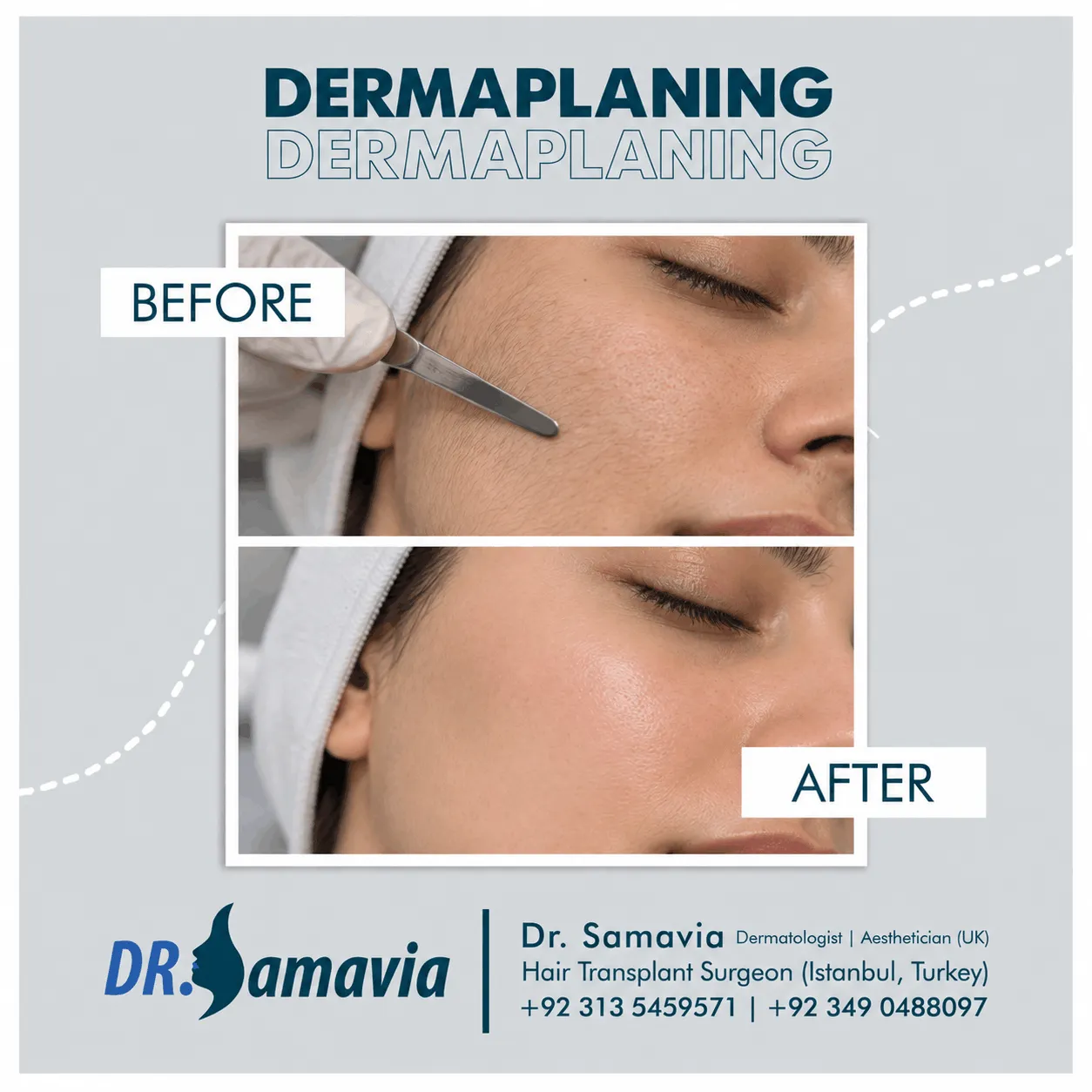
Dermaplaning is a non-invasive to minimally invasive cosmetic exfoliation procedure in which a sterile surgical blade or specialised dermaplaning instrument is gently passed across the skin to remove superficial dead skin cells and fine vellus hair, commonly called “peach fuzz.”
The treatment can leave the skin temporarily smoother and brighter and may improve the way makeup and skincare products sit on the skin. Dermaplaning does not permanently remove facial hair, change the structure of hair follicles or cause vellus hair to grow back thicker or darker.
What is Dermaplaning?
Dermaplaning is a superficial skin-resurfacing technique that mechanically removes part of the outermost layer of dead skin cells together with fine facial vellus hair.
During professional treatment, the skin is held taut while a sterile blade is moved carefully across the surface at a controlled angle.
The treatment primarily affects the stratum corneum, the outermost portion of the epidermis.
Dermaplaning can remove:
- Superficial dead skin cells
- Fine vellus facial hair
- Surface debris
- Some superficial roughness
Because it is a relatively superficial procedure, dermaplaning generally involves less downtime than deeper treatments such as laser resurfacing, deeper chemical peels or dermabrasion.
It should not be confused with dermabrasion, which is a considerably more aggressive resurfacing procedure that removes deeper layers of skin.
What Is Dermaplaning Used For?
Dermaplaning may be considered for cosmetic concerns including:
- Dull-looking skin
- Rough surface texture
- Fine facial vellus hair
- Dry or flaky surface skin
- Mild superficial unevenness
- General facial exfoliation
- Preparation of the skin before selected cosmetic treatments
- Improving the smooth application of makeup
Some patients also choose dermaplaning because removal of fine facial hair creates a temporarily smoother appearance.
Dermaplaning should primarily be viewed as a superficial exfoliation and temporary vellus-hair removal procedure rather than treatment for significant wrinkles, deep acne scars or medical skin conditions.
A Personalized Approach to Dermaplaning
Skin texture, sensitivity and cosmetic concerns differ from patient to patient, so Dermaplaning should be planned according to the individual's skin condition, current skincare, treatment history and goals rather than performed as the same routine treatment for everyone.
Before recommending Dermaplaning, Dr. Samavia assesses each patient individually, considering skin sensitivity, active acne, dryness or flaking, pigmentation tendency, current skincare products, prescription treatments, previous cosmetic procedures, history of abnormal scarring and any active skin condition that could increase the risk of irritation or complications.
The first priority is to determine whether the patient's concern is suitable for a superficial exfoliation procedure. Dermaplaning may be appropriate for selected patients seeking improvement in dull-looking skin, mild surface roughness, superficial dry or flaky skin and temporary removal of fine facial vellus hair.
Patients with active inflammatory acne, open wounds, significant dermatitis, eczema flare, psoriasis, active infection, cold sores or significant skin irritation may need treatment postponed until the skin has recovered or the underlying condition has been appropriately managed.
If Dermaplaning is considered suitable, Dr. Samavia develops an individual treatment plan based on the patient's skin tolerance and cosmetic objectives. Treatment may focus on the full face or selected areas and may be accompanied by gentle skincare, hydration, appropriate moisturisation and sun protection.
Depending on the concern, the broader skin-treatment plan may also include medical-grade skincare, Hydrafacial, superficial chemical peels, microneedling, laser resurfacing, pigmentation treatment or other clinically appropriate procedures. Combination treatment is selected carefully because performing multiple exfoliating procedures together can increase skin-barrier disruption and irritation.
Patients should understand that Dermaplaning provides superficial and temporary improvement. It does not permanently remove facial hair, destroy hair follicles, correct deep acne scars, permanently tighten skin or permanently remove pigmentation.
Dermaplaning also does not cause fine facial hair to biologically grow back thicker or darker. Because the hair is cut at the skin surface rather than removed from or damaged at the follicle, the vellus hair gradually returns according to its natural growth cycle.
Monitoring Skin Response and Treatment Results
Dermaplaning produces relatively immediate cosmetic changes, so patients may notice smoother-feeling skin, removal of fine vellus hair and a temporarily brighter appearance shortly after treatment.
Dr. Samavia evaluates the skin's response and, where appropriate, monitors redness, sensitivity, dryness, irritation and overall improvement in surface texture before recommending repeat treatment or combining dermaplaning with another procedure.
Because the skin naturally continues to shed and renew superficial cells and vellus hair naturally regrows, the effect gradually diminishes over time. There is therefore no universal treatment interval that is appropriate for every patient.
Repeat treatment should be considered only after the skin has recovered adequately. Excessive or overly frequent exfoliation can weaken the skin barrier and contribute to dryness, irritation or sensitivity.
Patients receive personalised guidance regarding cleansing, moisturising, sunscreen use, retinoids, exfoliating acids, facial scrubs and other active skincare products during the recovery period. Appropriate sun protection is particularly important after exfoliation because freshly treated skin may temporarily be more sensitive.
If you are considering Dermaplaning in Islamabad, you can book a consultation with Dr. Samavia for an individual skin assessment and personalised treatment plan.
What concerns can it address?
Dull-looking skin
Dead skin cells accumulating on the surface can make skin appear less smooth or radiant.
Removing this superficial layer may temporarily produce a brighter-looking complexion.
Fine facial hair
Dermaplaning removes vellus hair from the surface of the face.
Common treatment areas may include:
- Cheeks
- Jawline
- Chin
- Forehead
- Upper lip area
The hair eventually grows back because dermaplaning does not destroy the hair follicle.
Rough surface texture
Superficial exfoliation can temporarily make the skin feel smoother.
It cannot correct deeper structural textural problems to the same degree as procedures such as laser resurfacing or microneedling.
Flaky skin
Removal of superficial dead cells can improve the appearance of mild surface flaking in suitable patients.
Persistent dryness or scaling caused by eczema, dermatitis or another medical condition requires appropriate diagnosis rather than repeated exfoliation.
Superficial skin imperfections
Dermaplaning may soften the appearance of mild surface irregularities, but expectations should remain conservative.
Deep acne scars generally require more targeted treatments.
Potential benefits
Potential benefits of Dermaplaning include:
- Immediate removal of fine vellus hair
- Superficial exfoliation
- Smoother-feeling skin
- Brighter-looking complexion
- Improved temporary skin softness
- Makeup may apply more smoothly
- No injections
- No surgical incisions
- Usually minimal downtime
- Can be combined with selected skincare treatments when appropriate
Cleveland Clinic describes dermaplaning as a superficial exfoliating procedure that can make skin appear smoother and brighter while removing peach fuzz.
The treatment can be useful for patients seeking relatively gentle cosmetic maintenance rather than dramatic skin resurfacing.
Limitations and realistic expectations
Dermaplaning provides temporary superficial improvement.
It cannot reliably:
- Permanently remove facial hair
- Stop hair growth
- Permanently shrink pores
- Remove deep acne scars
- Remove deep wrinkles
- Permanently tighten loose skin
- Cure acne
- Permanently remove pigmentation
- Replace laser resurfacing
- Replace microneedling for deeper scars
- Change the biological structure of the skin after one session
Clinical evidence specifically supporting dermaplaning for significant facial rejuvenation remains limited.
A systematic review examining dermaplaning and other non-invasive facial rejuvenation techniques found that the scientific evidence available for dermaplaning was relatively scarce and not well documented.
Patients should therefore be cautious about claims such as:
- “Permanent glass skin”
- “Permanent facial hair removal”
- “Deep acne scars removed in one session”
- “Permanent pore tightening”
- “Instant collagen reconstruction”
- “Hair will never grow back”
These claims are not supported by the mechanism or available evidence.
Does Dermaplaning Make Hair Grow Back Thicker?
No.
Dermaplaning cuts vellus hair at the skin surface. It does not alter:
- The hair follicle
- Hair diameter at the follicular level
- Number of hair follicles
- Hair-growth rate
- Hormonal control of hair growth
When shaved hair begins to regrow, the cut end may initially feel slightly blunt or coarse.
This can create the impression that the hair is thicker.
However, shaving or dermaplaning does not cause hair to biologically grow back thicker, darker or faster.
The regrowing vellus hair eventually returns to its natural appearance and texture.
Patients with genuinely increasing coarse facial hair may have hormonal or other medical factors contributing to hair growth and may benefit from separate assessment.
Who may be suitable?
Dermaplaning may be considered for adults with:
- Fine facial vellus hair
- Dull-looking skin
- Mild surface roughness
- Superficial dry or flaky skin
- General exfoliation goals
- Preference for a treatment with minimal downtime
A skin assessment should consider:
- Skin sensitivity
- Current acne
- Active skin conditions
- Current skincare
- Recent cosmetic treatments
- Medication
- History of pigmentation
- Tendency toward scarring
- Treatment expectations
Patients should understand that dermaplaning is primarily a maintenance and exfoliation treatment rather than a corrective procedure for significant skin disease.
Who may not be suitable?
Dermaplaning may need to be postponed or avoided when there is:
- Active inflammatory acne
- Open wounds
- Active bacterial infection
- Active cold sores
- Significant eczema flare
- Significant dermatitis
- Active psoriasis in the treatment area
- Sunburn
- Severe skin irritation
- Significant recent facial injury
Dermaplaning directly over inflamed acne can irritate lesions and potentially increase inflammation or bacterial exposure.
Cleveland Clinic specifically advises avoiding dermaplaning during active acne breakouts and active inflammatory skin conditions.
Additional caution may be required in patients with:
- Significant tendency toward keloid or hypertrophic scars
- Very reactive skin
- Recent aggressive resurfacing treatments
- Certain medicines that significantly affect skin healing
A patient with unexplained skin lesions should have them diagnosed before cosmetic scraping or exfoliation.
How to prepare
Before Dermaplaning, tell your provider about:
- Prescription skincare
- Retinoids
- Acne medication
- Previous isotretinoin
- Exfoliating acids
- Allergies
- Active acne
- Eczema
- Psoriasis
- Cold sores
- Recent chemical peels
- Recent microneedling
- Laser treatments
- Recent waxing
- Sunburn
- Previous abnormal scarring
Depending on your skin and treatment protocol, you may be advised temporarily to avoid:
- Strong retinoids
- Aggressive exfoliating acids
- Facial scrubs
- Other irritating treatments
before the appointment.
The skin should generally be clean and free of heavy makeup before treatment.
Do not stop prescribed dermatological medication without discussing it with the clinician responsible for your care.
How the procedure works
1. Skin assessment
The provider checks the skin for:
- Active acne
- Infection
- Irritation
- Open wounds
- Other contraindications
2. Cleansing
Makeup, oil and surface impurities are removed.
The skin is thoroughly cleansed and dried.
3. Skin positioning
The skin is held gently taut to create a controlled treatment surface.
4. Dermaplaning
A sterile surgical blade or specialised dermaplaning instrument is moved carefully across the skin.
The blade removes superficial dead skin cells and fine vellus hair.
Treatment is generally performed in controlled sections rather than aggressively scraping the entire face at once.
5. Completion
Loose skin debris and hair are removed.
The skin is checked for:
- Redness
- Irritation
- Small nicks
- Unexpected reactions
6. Skincare
A gentle moisturiser or soothing product may be applied.
Broad-spectrum sunscreen is particularly important after exfoliation because freshly treated skin may be more sensitive to ultraviolet exposure.
Results and treatment timeline
Dermaplaning produces relatively immediate cosmetic changes.
Immediately after treatment
Patients may notice:
- Smoother skin
- Removal of peach fuzz
- Softer-feeling skin
- Increased temporary brightness
- Smoother makeup application
The skin may also temporarily appear slightly pink.
First 24 to 48 hours
Some patients experience:
- Mild sensitivity
- Tightness
- Dryness
- Temporary redness
Gentle skincare is usually recommended during this period.
Following several weeks
The exfoliation effect gradually diminishes as new dead skin cells accumulate.
Vellus hair also naturally regrows.
Repeat treatment
Some patients choose periodic dermaplaning for cosmetic maintenance.
There is no medically required universal treatment interval.
The skin should have adequately recovered before another procedure is performed, and excessive exfoliation should be avoided.
Risks and side effects
Dermaplaning is generally considered a relatively low-risk cosmetic procedure when performed appropriately, but complications can occur.
Temporary effects may include:
- Redness
- Dryness
- Tightness
- Mild burning or stinging
- Temporary sensitivity
- Minor irritation
Other potential complications include:
Small cuts or nicks
Because treatment uses a blade, superficial cuts can occur.
Infection
Breaking the skin barrier can allow bacteria to enter, particularly if instruments or treatment technique are not appropriately hygienic.
Acne flare
Dermaplaning may irritate active acne or contribute to breakouts in susceptible patients.
Pigmentation changes
Post-inflammatory hyperpigmentation or hypopigmentation may occur following significant irritation or injury.
Scarring
Scarring is uncommon with gentle superficial treatment but remains possible if the skin is cut or significantly injured.
Cleveland Clinic lists infection, abnormal scarring and skin-colour changes among potential risks of professional dermaplaning.
Appropriate technique, sterile instruments and correct patient selection help reduce avoidable complications.
Recovery and aftercare
Most routine cosmetic dermaplaning treatments require little downtime.
Patients may usually return to normal activities immediately.
For the first several days, patients may be advised to:
- Use a gentle cleanser.
- Apply an appropriate moisturiser.
- Avoid aggressive scrubs.
- Avoid picking or scratching the skin.
- Temporarily avoid strong exfoliating acids.
- Temporarily avoid retinoids if advised.
- Avoid unnecessary waxing or other facial exfoliation.
- Protect the skin from excessive sun exposure.
- Use broad-spectrum sunscreen daily.
Because dermaplaning temporarily disrupts the superficial skin barrier, applying multiple strong active ingredients immediately after treatment may increase irritation.
Contact the clinic if you develop:
- Increasing pain
- Significant persistent redness
- Pus or discharge
- Blistering
- Significant swelling
- Persistent rash
- Signs of infection
- Another unexpected reaction
Alternatives and comparisons
The most appropriate alternative depends on the patient's treatment goal.
For Facial Hair
Options may include:
- Shaving
- Threading
- Waxing
- Laser Hair Removal
- Electrolysis
Dermaplaning removes fine hair temporarily but does not destroy the follicle.
For Superficial Exfoliation
Options may include:
- Medical-grade skincare
- Superficial chemical peels
- Microdermabrasion
- Hydrafacial
- Enzyme-based exfoliation
For Acne Scars
More appropriate options for selected acne scars may include:
- Microneedling
- Radiofrequency microneedling
- Fractional laser resurfacing
- Subcision
- Chemical reconstruction techniques
- Selected dermal fillers
- Combination scar treatment
The correct option depends on the scar type.
Dermaplaning vs Hydrafacial
Dermaplaning mechanically removes superficial dead skin cells and fine vellus hair using a blade.
Hydrafacial combines cleansing, exfoliation, suction-assisted extraction and hydrating serum delivery.
Hydrafacial does not normally remove facial vellus hair in the same way dermaplaning does.
Dermaplaning vs Microdermabrasion
Both are superficial exfoliation treatments.
Dermaplaning uses a blade to remove surface skin cells and vellus hair.
Microdermabrasion uses an abrasive tip or particles with suction to exfoliate the skin.
The most appropriate method depends on skin type and cosmetic goals.
Dermaplaning vs Chemical Peel
A chemical peel uses an acidic or chemical solution to produce controlled exfoliation.
Dermaplaning physically exfoliates the skin using a blade.
Chemical peels can vary from superficial to considerably deeper treatments, while routine cosmetic dermaplaning remains relatively superficial.
Dermaplaning vs Laser Hair Removal
Dermaplaning cuts hair at the skin surface.
Laser Hair Removal targets pigment in suitable hair follicles with the goal of producing long-term hair reduction.
Dermaplaning is therefore temporary hair removal and should not be presented as an alternative that produces permanent reduction.
Laser hair removal also responds poorly to very fine, lightly pigmented vellus hair in many cases.
What affects the cost?
The cost of Dermaplaning may depend on:
- Treatment area
- Full-face versus selected-area treatment
- Practitioner expertise
- Products applied afterward
- Whether treatment is combined with a facial
- Whether a superficial peel is added
- Clinic treatment protocol
- Follow-up skincare
Dermaplaning is often combined commercially with:
- Hydrafacial
- Facial treatments
- Light chemical peels
- Hydrating masks
However, adding more exfoliation does not automatically produce a better result.
Combination treatment should be selected according to skin tolerance to avoid excessive barrier disruption and irritation.
Patient experiences
Reviews describe individual experiences and do not predict another patient's result.
I had a wonderful experience consulting with Dr. Samaviya Ejaz. She is an incredibly impressive and professional dermatologist. Her clinic is beautiful and has a calming atmosphere.
Umar Shah
Read on GoogleI had my hair fall consultation with Dr Samavia. She thoroughly explained the treatment. After PRF sessions my hair fall stopped and density improved. Highly recommend.
Moneeb Mumtaz
Read on GoogleI have had a few treatments at this clinic and I am happy with the outcomes. Dr. Samavia and her team are kind, professional, and trustworthy.
Sheikh Yousuf Kareem
Read on GoogleVisit Dr Samavia at Facetime Clinic
Use the verified Google profile for clinic directions, business details and linked patient reviews.
Clinical references
- Dermaplaning: What It Is, Benefits & Side EffectCleveland Clinic · accessed 30 August 2026
- Is It OK to Try Dermaplaning at Home?Cleveland Clinic · accessed 30 August 2026
- Dermabrasion and DermaplaningAmerican Society of Plastic Surgeons · accessed 30 August 2026
- Dermaplaning, Topical Oxygen, and Photodynamic Therapy: A Systematic Review of the LiteratureAesthetic Plastic Surgery / PubMed · accessed 30 August 2026
Dermaplaning FAQs
What does Dermaplaning do?
Dermaplaning removes superficial dead skin cells and fine vellus facial hair using a sterile blade or specialised instrument. It can temporarily make the skin feel smoother and appear brighter, but it does not provide deep skin resurfacing or permanently change the skin.
Does hair grow back thicker after Dermaplaning?
No. Dermaplaning cuts hair at the skin surface and does not change the hair follicle. The hair may initially feel slightly blunt as it regrows because it was cut straight across, but dermaplaning does not make facial hair biologically grow back thicker, darker or faster.
How long do Dermaplaning results last?
The smoothness and hair-free appearance are temporary. Vellus hair naturally regrows and dead skin cells accumulate again over time. Duration varies between individuals, and repeat treatment may be considered after the skin has fully recovered.
Is Dermaplaning good for acne?
Dermaplaning is generally not recommended directly over active inflammatory acne because the blade can irritate lesions and potentially contribute to further inflammation or bacterial exposure. Patients with active acne should first receive appropriate acne treatment. Dermaplaning may be considered later for suitable skin once inflammation is controlled.
Is Dermaplaning the same as shaving?
Both cut hair at the skin surface, but professional dermaplaning is performed primarily as a controlled cosmetic exfoliation procedure using a specialised blade or instrument. It removes both superficial dead skin cells and vellus hair. Neither method permanently changes the hair follicle.
Other Face Treatments guides
Book a consultation in Islamabad to review suitability, alternatives, expected recovery and individual risks.