
DHI Hair Transplant in Islamabad
DHI hair transplant is a surgical hair-restoration approach in which individual follicular units are usually harvested from a donor area using FUE and then implanted into planned areas of hair loss with an implanter device. The technique allows the surgeon to control graft placement, direction and distribution according to the treatment plan.
DHI is commonly promoted as a separate hair-transplant technique, but medically it is more accurately considered an implantation method used as part of follicular-unit hair transplantation. Suitability depends on the cause and pattern of hair loss, donor-hair availability, scalp health and the patient's long-term hair-loss pattern.
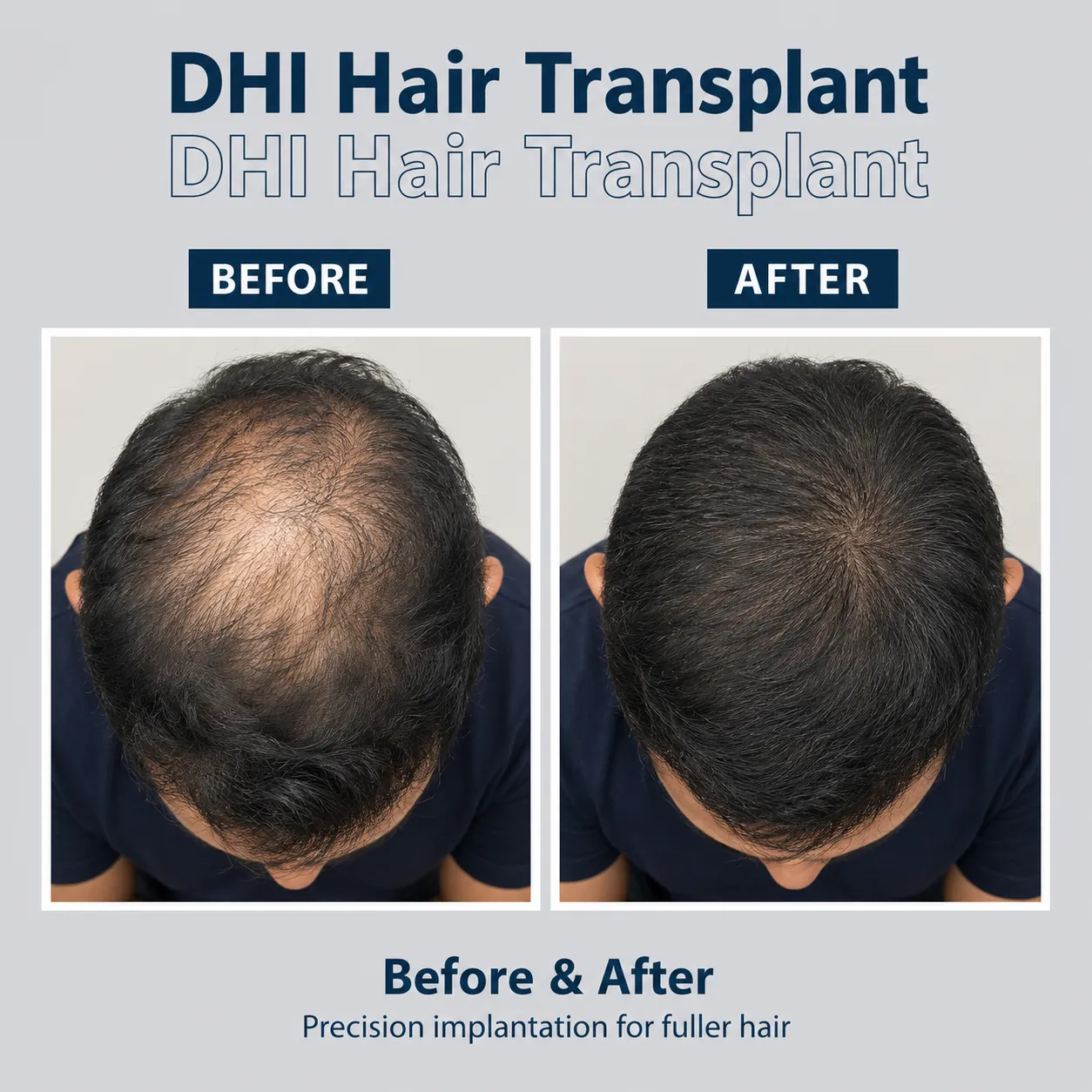
What is DHI Hair Transplant?
DHI (Direct Hair Implantation) is a term commonly used for hair transplantation in which harvested follicular-unit grafts are placed into the recipient scalp using a specialised implanter device.
In many DHI procedures, individual follicular units are first removed from a suitable donor area, commonly the back or sides of the scalp, using the Follicular Unit Excision (FUE) technique. The extracted grafts are assessed and prepared before implantation.
An implanter device holds the follicular-unit graft and allows it to be placed into the scalp according to the planned depth, angle and direction. Depending on the device and technique, implantation may occur into previously prepared sites or the device may create the recipient opening while inserting the graft.
The International Society of Hair Restoration Surgery describes DHI as an implantation technique rather than a completely separate method of hair transplantation. The quality of the final result therefore depends considerably on diagnosis, donor management, hairline design, graft handling, surgical planning and operator expertise.
What Is DHI Hair Transplant Used For?
DHI hair transplantation may be considered for selected patients with permanent or progressive hair loss who have a suitable donor area.
It is most commonly discussed for androgenetic alopecia, also known as male or female pattern hair loss. Depending on the patient's condition and available donor supply, transplantation may be used to reconstruct or improve:
- Receding hairlines
- Frontal hair loss
- Temporal recession
- General scalp thinning
- Crown or vertex hair loss
- Selected areas of previous hair-transplant thinning
Hair transplantation does not treat every form of hair loss. Establishing the diagnosis before surgery is important because some inflammatory, autoimmune, nutritional, hormonal or temporary causes of hair loss may require medical treatment rather than transplantation.
A Personalized DHI Hair Restoration Plan
A successful hair transplant depends on much more than choosing an implantation device or requesting a particular number of grafts. The treatment plan should be based on the cause and pattern of hair loss, donor-hair quality, scalp condition, existing hair density, medical history and the expected progression of future hair loss.
Before recommending DHI hair transplantation, Dr. Samavia assesses each patient individually. The consultation includes evaluation of the pattern of hair loss, donor area, scalp health, previous treatments, relevant medical history and the patient's expectations. This assessment helps determine whether hair transplantation is appropriate and whether DHI-style implantation is suitable for the planned procedure.
When required, the overall hair-restoration plan may also include medical management of ongoing hair loss, treatment of clinically identified deficiencies, scalp and hair-care guidance, postoperative care and scheduled follow-up. Not every patient requires the same combination of treatments.
Long-term planning is especially important because transplanted follicles are obtained from a limited donor supply, while existing non-transplanted hair may continue to thin in patients with progressive androgenetic alopecia. The objective is therefore not simply to implant the maximum number of grafts, but to use the available donor hair strategically while considering how the patient's hair loss may develop in the future.
Dr. Samavia audits patient outcomes and treatment progress as part of her clinical approach. These reviews help evaluate treatment results, postoperative recovery and follow-up protocols and support ongoing refinement of patient selection and treatment planning.
Patients undergoing DHI hair transplantation also receive personalised guidance regarding preparation, postoperative scalp care, medications when clinically indicated, activity restrictions and follow-up. Following the recommended treatment and aftercare plan can support recovery and help achieve the best possible outcome for the individual patient, although results vary according to patient and clinical factors.
If you are considering a DHI hair transplant in Islamabad, you can book a consultation with Dr. Samavia for an individual hair-loss assessment and personalised hair-restoration plan.
What concerns can it address?
DHI hair transplantation may be considered when permanent hair follicles remain available in the donor region but hair has been lost or significantly miniaturised in another area.
It may help improve the appearance of a receding hairline, frontal thinning, pattern baldness or selected areas of reduced density.
The procedure cannot produce unlimited density. The achievable result is restricted by donor-hair availability, hair characteristics, existing hair loss, scalp condition and the amount of future hair loss expected.
Potential benefits
- Uses the patient's own naturally growing hair follicles.
- Individual follicular units can be positioned according to the planned hair direction and distribution.
- Implanter devices can reduce direct handling of the follicle bulb during insertion.
- When grafts are harvested using FUE, a long linear donor scar is usually avoided.
- Hairline design and graft distribution can be customised to the patient's facial proportions and existing hair.
- Successfully transplanted follicles are intended to continue producing hair over the long term.
DHI should not automatically be considered superior to other properly performed hair-transplant implantation methods. Surgical planning, surgeon experience, graft quality and donor management are more important than the marketing name of a particular technique.
Limitations and realistic expectations
DHI is a surgical procedure and cannot guarantee a particular graft-survival percentage, density or cosmetic result.
It does not create new hair follicles. Existing follicles are redistributed from a donor region to areas where additional coverage is required, meaning the donor supply is limited.
DHI also does not stop the progression of androgenetic alopecia. Non-transplanted hair surrounding the transplanted follicles may continue to thin with time, and appropriate medical treatment may therefore be discussed when indicated.
Very advanced hair loss, poor donor density or unrealistic density expectations may limit what can safely be achieved.
Despite occasional marketing claims, FUE-based DHI transplantation is not genuinely “scarless.” Removing follicular units creates multiple very small donor-site wounds that normally heal as small scars.
Who may be suitable?
Hair transplantation may need to be postponed or may not be recommended in patients with:
- Active scalp infection or significant inflammation.
- Certain active scarring alopecias.
- Unexplained or rapidly progressing hair loss.
- Alopecia areata affecting the proposed area.
- Insufficient or severely miniaturised donor hair.
- Significant uncontrolled medical conditions.
- Bleeding or clotting disorders requiring further assessment.
- Certain medications affecting bleeding or healing.
- Unrealistic expectations about achievable density.
- A hair-loss pattern that cannot be treated safely using the available donor supply.
A medical consultation and scalp assessment are required before determining suitability.
Who may not be suitable?
Hair transplantation may need to be postponed or may not be recommended in patients with:
- Active scalp infection or significant inflammation.
- Certain active scarring alopecias.
- Unexplained or rapidly progressing hair loss.
- Alopecia areata affecting the proposed area.
- Insufficient or severely miniaturised donor hair.
- Significant uncontrolled medical conditions.
- Bleeding or clotting disorders requiring further assessment.
- Certain medications affecting bleeding or healing.
- Unrealistic expectations about achievable density.
- A hair-loss pattern that cannot be treated safely using the available donor supply.
A medical consultation and scalp assessment are required before determining suitability.
How to prepare
Before DHI hair transplantation, provide a complete medical history and disclose medications, supplements, allergies, previous operations and previous hair-loss treatments.
Your clinician may assess:
- Pattern and cause of hair loss
- Donor density
- Hair calibre and texture
- Scalp condition
- Previous hair-transplant procedures
- Family history of progressive hair loss
- Expectations and desired hairline
- Estimated graft requirement
Follow the clinic's instructions regarding hair washing, smoking, alcohol, food and medicines before surgery.
Do not stop aspirin, anticoagulants, blood-pressure medicines or any other prescribed medication unless the prescribing clinician or surgical team specifically advises you to do so.
How the procedure works
- Assessment and planning: The pattern of hair loss, donor supply and treatment goals are evaluated.
- Hairline and recipient design: The surgeon plans the hairline, distribution and areas requiring transplantation.
- Local anaesthesia: Local anaesthetic is administered to the donor and treatment areas.
- Follicular-unit harvesting: Individual grafts are commonly excised from the donor area using FUE techniques.
- Graft preparation: Harvested follicular units are inspected, organised and maintained appropriately before implantation.
- Implantation: Follicular-unit grafts are placed into the recipient scalp using an implanter device according to the planned direction, angle and distribution.
- Final assessment: Donor and recipient areas are examined before the patient receives postoperative instructions.
The number of grafts and duration of surgery depend on the degree of hair loss, available donor supply and treatment plan.
Results and treatment timeline
Hair-transplant results develop gradually because transplanted follicles follow the normal biological hair-growth cycle.
During the first several days, redness, tenderness and small crusts around implanted grafts are common.
Some transplanted hair shafts commonly shed during the first few weeks. This does not necessarily mean that the transplanted follicles have been lost.
New hair growth may begin to become noticeable at approximately 3 to 4 months.
Density and hair calibre generally continue to develop over subsequent months. A more meaningful assessment is often possible around 6 to 12 months, while maturation can continue beyond this point.
Depending on the individual and treatment area, final results may take approximately 10 to 18 months to become established.
Existing non-transplanted hair can continue to thin, so long-term hair-loss management should be considered as part of treatment planning.
Risks and side effects
Hair transplantation is surgery and has potential risks despite being commonly performed.
Temporary effects can include:
- Scalp tenderness
- Redness
- Swelling
- Small scabs or crusts
- Itching
- Temporary numbness
- Mild bleeding
- Tightness in the donor area
Other potential complications include:
- Infection
- Folliculitis
- Prolonged numbness or altered sensation
- Temporary shedding of surrounding hair
- Poor or uneven graft growth
- Visible donor-area thinning
- Unnatural graft direction or hairline appearance
- Pigment changes
- Cysts
- Noticeable scarring
- Unsatisfactory density or cosmetic outcome
- Reaction to medications or local anaesthetic
Hair transplantation should therefore be planned and performed with appropriate medical and surgical supervision.
Recovery and aftercare
The transplanted grafts require particular care during early recovery.
Follow the clinic's specific instructions regarding scalp washing, sleeping position, medication, exercise and application of recommended products.
Patients are commonly advised to avoid rubbing, scratching or directly traumatizing the transplanted area during the early healing period.
Small crusts generally develop around transplanted follicles and gradually resolve. Swelling around the forehead or scalp can occur temporarily.
Strenuous exercise, swimming and other activities that could disrupt healing may need to be temporarily restricted.
Contact the clinic if you experience increasing pain, spreading redness, unusual discharge, significant bleeding, fever or another unexpected symptom.
Alternatives and comparisons
The most appropriate alternative depends on the diagnosis, degree of hair loss, donor availability and patient preference.
Options may include:
- Medical treatment for androgenetic alopecia when clinically appropriate
- Standard FUE hair transplantation using other implantation methods
- FUT or strip hair transplantation
- PRP treatment
- Low-level laser therapy
- Scalp micropigmentation
- Cosmetic hair fibres or camouflage products
- Hair systems
- Observation without surgical treatment
DHI vs FUE: These terms do not necessarily describe competing procedures. FUE describes how individual follicular units are surgically harvested from the donor area, while DHI is commonly used to describe how those grafts are implanted with an implanter device. A procedure advertised as DHI may therefore use FUE for graft harvesting.
No single technique is automatically best for every patient.
What affects the cost?
The cost of DHI hair transplantation can vary according to:
- Number of grafts required
- Size of the treatment area
- Degree of existing hair loss
- Donor-area characteristics
- Complexity of hairline reconstruction
- Previous hair-transplant surgery
- Length of the surgical procedure
- Surgical team and clinician expertise
- Postoperative follow-up included in the treatment package
A graft estimate should be made after assessment rather than promising a fixed graft number or density before examining the donor and recipient areas.
Treatment planning should prioritise safe donor management and a realistic long-term result rather than simply transplanting the maximum possible number of grafts.
Patient experiences
Reviews describe individual experiences and do not predict another patient's result.
I had a wonderful experience consulting with Dr. Samaviya Ejaz. She is an incredibly impressive and professional dermatologist. Her clinic is beautiful and has a calming atmosphere.
Umar Shah
Read on GoogleI had my hair fall consultation with Dr Samavia. She thoroughly explained the treatment. After PRF sessions my hair fall stopped and density improved. Highly recommend.
Moneeb Mumtaz
Read on GoogleI have had a few treatments at this clinic and I am happy with the outcomes. Dr. Samavia and her team are kind, professional, and trustworthy.
Sheikh Yousuf Kareem
Read on GoogleVisit Dr Samavia at Facetime Clinic
Use the verified Google profile for clinic directions, business details and linked patient reviews.
Clinical references
- Hair transplantNHS · accessed 29 August 2026
- Surgical Treatments for Hair LossInternational Society of Hair Restoration Surgery (ISHRS) · accessed 29 August 2026
- Why FUE Is So ConfusingInternational Society of Hair Restoration Surgery (ISHRS) · accessed 29 August 2026
- Hair transplantation: Surgical techniqueJournal of the American Academy of Dermatology / PubMed · accessed 29 August 2026
DHI Hair Transplant FAQs
What is a DHI hair transplant?
DHI, or Direct Hair Implantation, is a hair-transplant approach in which individual follicular-unit grafts are harvested from a donor area and implanted into areas of hair loss using a specialised implanter device. In many cases, FUE is used to harvest the grafts before DHI implantation.
Is DHI better than FUE hair transplant?
DHI and FUE do not always describe competing techniques. FUE generally refers to how individual follicular units are removed from the donor area, while DHI commonly refers to how those grafts are implanted. The most suitable approach depends on the patient's hair-loss pattern, donor supply, treatment area and surgical plan.
Is DHI hair transplant permanent?
Successfully transplanted follicles are intended to provide long-term hair growth because they are usually taken from donor areas that are relatively resistant to androgenetic hair loss. However, existing non-transplanted hair can continue to thin over time, so ongoing hair-loss management may still be required.
How long does it take to see results after DHI hair transplant?
Some transplanted hairs commonly shed during the first few weeks. New growth may start becoming noticeable after approximately 3 to 4 months. Density and thickness usually continue to improve over subsequent months, with a more complete result commonly assessed around 10 to 18 months.
How many grafts do I need for a DHI hair transplant?
The required number of grafts varies according to the size of the area being treated, existing hair density, donor availability, hair calibre, desired coverage and future hair-loss pattern. An accurate graft estimate should be made after examination of the scalp and donor area.
Does DHI hair transplant leave scars?
DHI performed with FUE harvesting usually avoids the long linear scar associated with strip surgery, but it is not completely scarless. Removing individual follicular units creates many very small donor-site wounds that typically heal as tiny scars, which are often difficult to notice when the donor area has adequate hair coverage.
Other Hair Procedures guides
Book a consultation in Islamabad to review suitability, alternatives, expected recovery and individual risks.