
Plasma Skin Treatment in Islamabad
Plasma Skin Treatment, often called Plasma Pen, Plasma Exeresis or Fibroblast Plasma Treatment, is an energy-based aesthetic procedure that creates a controlled electrical plasma arc near the skin surface. The energy produces small, controlled areas of thermal injury with the aim of improving selected superficial skin lesions or producing a modest tightening effect through wound healing and collagen remodelling.
Plasma treatment is not the same as PRP (Platelet-Rich Plasma), which is prepared from a patient's own blood. The evidence for cosmetic plasma-pen skin tightening remains relatively limited, and outcomes depend on the device, treatment area, skin type, energy settings and practitioner technique. Burns, pigmentation changes and scarring are important potential complications.
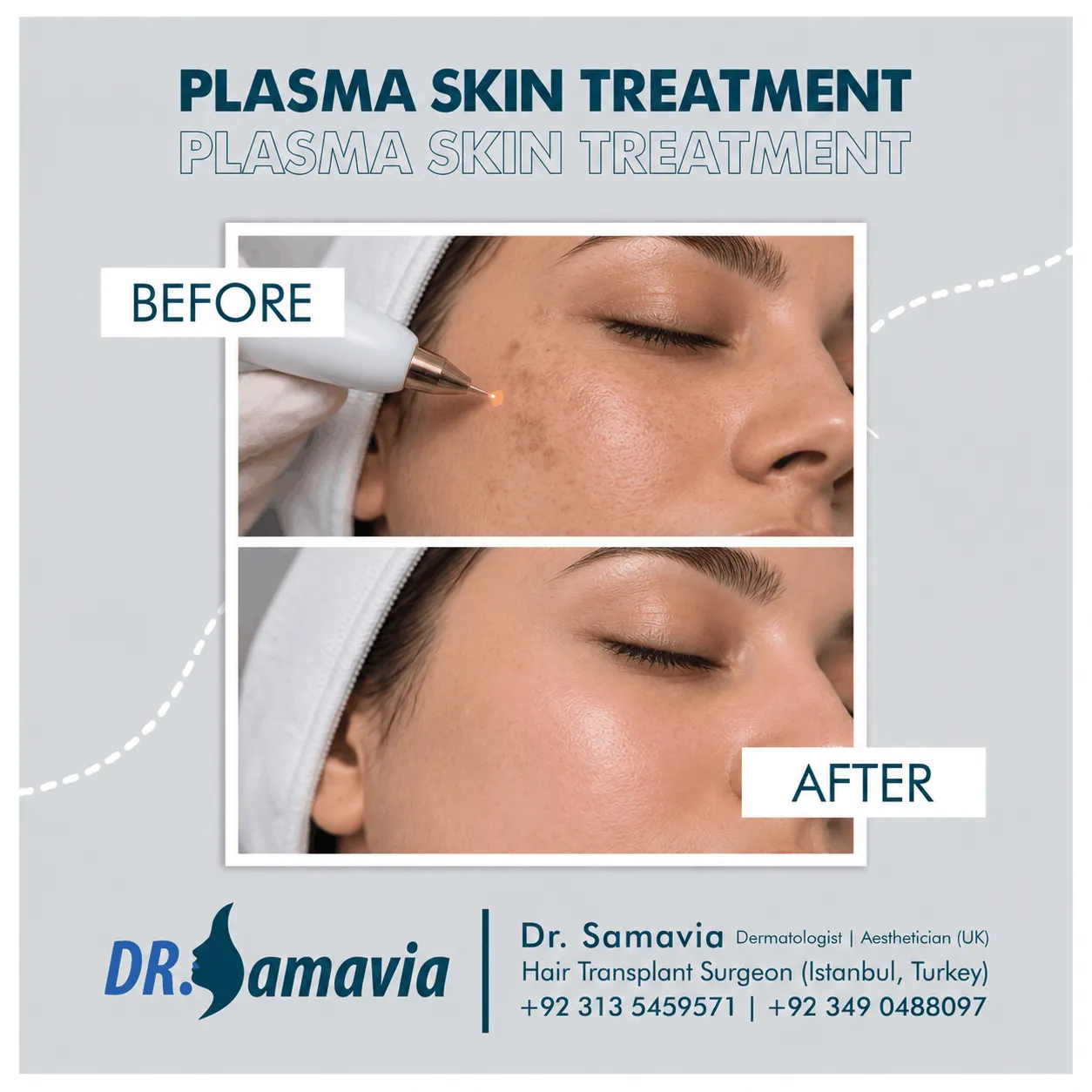
What is Plasma Skin Treatment?
Plasma Skin Treatment uses an electrical device that creates an ionised gas, or plasma arc, between the treatment tip and the skin.
In certain low-power plasma pen devices, the tip does not need to make direct physical contact with the skin. The electrical arc produces controlled thermal injury at small treatment points.
The subsequent healing response may involve:
- Superficial tissue contraction
- Formation of small crusts
- Collagen remodelling
- Changes in skin texture
- Gradual tissue healing
Plasma pen treatment is sometimes marketed as “fibroblast therapy.”
This term refers to the idea that controlled thermal injury and subsequent wound healing can influence fibroblast activity and collagen remodelling. It should not be confused with treatment involving cultured or injected fibroblast cells.
Plasma Pen should also not be confused with:
- PRP or Platelet-Rich Plasma
- PRF
- Plasma-derived blood products
- Helium plasma/RF systems used beneath the skin
- Surgical plasma devices
These technologies have very different mechanisms, indications and safety profiles.
What Is Plasma Skin Treatment Used For?
Depending on the specific device and local regulatory indication, plasma-based treatment may be considered for selected concerns such as:
- Mild superficial skin laxity
- Fine lines
- Selected wrinkles
- Upper-eyelid skin laxity in carefully selected patients
- Small benign superficial skin lesions with appropriate diagnosis
- Certain textural concerns
Some published clinical studies have investigated plasma exeresis for upper-eyelid dermatochalasis and periorbital wrinkles and have reported improvement in selected patients.
However, most studies are relatively small, and plasma treatment should not be presented as producing the same degree of correction as surgery.
A patient's treatment should also remain within the intended use of the specific device being used.
A Personalized Approach to Plasma Skin Treatment
Skin laxity, fine lines and textural concerns vary considerably between patients, so Plasma Skin Treatment should be planned according to the patient's skin type, treatment area, degree of laxity, pigmentation tendency, healing characteristics and cosmetic goals rather than using the same settings or treatment plan for everyone.
Before recommending Plasma Skin Treatment, Dr. Samavia assesses each patient individually, considering skin colour and type, degree of skin laxity, previous pigmentation problems, history of abnormal or keloid scarring, previous aesthetic procedures, medical history, medications, current skin condition and realistic expectations.
The first priority is to determine whether the patient's concern is suitable for a controlled plasma-based treatment. Selected patients with mild superficial skin laxity, fine lines, mild upper-eyelid skin excess or certain appropriately diagnosed superficial skin concerns may be considered. More significant tissue laxity, deep wrinkles or substantial eyelid skin excess may require another treatment approach or surgical assessment.
If Plasma Skin Treatment is considered appropriate, Dr. Samavia develops an individual treatment plan based on the patient's anatomy, skin response and treatment goals. Planning may include the specific treatment area, plasma device, energy settings, number and distribution of treatment points, treatment intensity and whether more than one session may be appropriate.
The exact device being used is particularly important because plasma systems can differ in their energy delivery, intended indications and safety profiles. Treatment should therefore be planned according to the specific technology rather than assuming that every procedure marketed as “Plasma Pen” produces the same result.
Particular attention is given to patients who may be more susceptible to post-inflammatory hyperpigmentation, prolonged colour changes or abnormal scarring. In these patients, the potential benefits and risks should be considered carefully before treatment.
Depending on the assessment, the wider skin-rejuvenation plan may instead or additionally include medical-grade skincare, chemical peels, microneedling, radiofrequency treatment, laser resurfacing, thread lifting, other energy-based procedures or surgical consultation where clinically appropriate.
Patients should understand that Plasma Skin Treatment generally produces modest and temporary improvement and should not be presented as equivalent to a surgical facelift or blepharoplasty. It cannot reliably remove substantial excess skin, permanently stop ageing or guarantee treatment without pigmentation changes or scarring.
Monitoring Healing and Treatment Results
Plasma Skin Treatment intentionally creates controlled superficial thermal injury, so the healing process is an important part of both treatment outcome and safety.
Immediately after treatment, redness, swelling, tenderness and small crust-like treatment points may be visible. These changes are expected to settle gradually, and the final cosmetic result should not be judged during the early healing period.
Dr. Samavia reviews treatment progress where appropriate, assessing healing, skin colour, swelling, texture, degree of tightening and any persistent pigmentation or scarring concerns.
Patients are advised not to pick or remove treatment crusts prematurely, as doing so may increase the risk of bleeding, infection, pigmentation changes or scarring. Careful sun protection is also particularly important because ultraviolet exposure during healing can increase the likelihood of post-inflammatory pigmentation.
Where appropriate, baseline and follow-up clinical photographs may be used to document the treatment area and compare changes after healing.
Because outcomes depend on skin type, treatment area, device, energy settings, healing response and practitioner technique, a specific degree or duration of tightening cannot be guaranteed. Additional treatment should only be considered after the previous treatment area has healed adequately and the response has been reviewed.
Patients receive personalised guidance regarding wound care, skincare, sun protection, exercise, heat exposure and when normal active skincare products can safely be restarted.
If you are considering Plasma Skin Treatment in Islamabad, you can book a consultation with Dr. Samavia for an individual skin assessment and personalised treatment plan.
What concerns can it address?
Mild skin laxity
Controlled plasma treatment may produce a modest tightening effect in selected patients with relatively mild skin looseness.
It cannot remove large amounts of excess skin.
Fine lines and wrinkles
Thermal treatment and subsequent healing may improve the appearance of selected superficial wrinkles.
Deep wrinkles caused by substantial volume loss or tissue descent usually require a different approach.
Upper-eyelid laxity
Plasma exeresis has been studied for mild-to-moderate upper-eyelid dermatochalasis.
Small clinical studies have reported improvement after multiple sessions.
However, plasma treatment is not equivalent to surgical blepharoplasty and should not be used when excess skin is severe or when eyelid function requires surgical assessment.
Selected benign skin lesions
Certain properly classified low-power plasma devices may be intended for destruction or removal of selected superficial benign skin lesions.
Any lesion that is suspicious, changing or diagnostically uncertain should be medically assessed before destructive treatment.
Potential benefits
Potential benefits may include:
- Minimally invasive treatment
- No traditional surgical incision
- Relatively small treatment areas can be targeted
- May provide modest tightening in appropriately selected patients
- Can improve selected superficial textural concerns
- Small clinical studies have reported improvement in mild-to-moderate upper-eyelid laxity
- Recovery is generally shorter than after surgical skin-removal procedures
The procedure may be attractive to selected patients who want modest improvement without undergoing surgery.
However, treatment should be selected according to the patient's anatomy and degree of skin laxity rather than marketed as a replacement for surgery.
Limitations and realistic expectations
Plasma Skin Treatment does not produce the same results as a surgical facelift or blepharoplasty.
It cannot reliably:
- Remove substantial excess skin
- Correct severe eyelid hooding
- Produce a surgical facelift result
- Permanently stop skin ageing
- Completely remove deep wrinkles
- Guarantee scar-free treatment
- Guarantee no pigmentation change
- Produce identical results in every skin type
Clinical evidence for cosmetic plasma pen procedures remains relatively limited compared with many established aesthetic treatments.
For example, studies of upper-eyelid plasma exeresis have included relatively small patient groups and often involve several treatment sessions.
Patients should therefore be cautious of marketing claims such as:
- “Non-surgical blepharoplasty with surgical results”
- “Permanent eyelid lift”
- “No risk of scarring”
- “Safe for every skin tone”
- “Zero downtime”
- “One-session permanent tightening”
These claims cannot be guaranteed.
Plasma Pen and Device Regulation
The exact plasma device matters.
The U.S. FDA currently classifies certain low-power plasma pen devices for skin-lesion destruction as Class II electrosurgical devices. These devices create an electrical arc between the probe and skin to cause controlled tissue damage.
This does not mean that every device marketed online as a Plasma Pen is FDA-cleared, nor does clearance for destroying selected skin lesions automatically establish clearance for every cosmetic claim such as eyelid lifting or wrinkle treatment.
Patients should ask:
- What is the exact device name?
- Who manufactures it?
- What is its intended use?
- Is it authorised or registered appropriately in the country where treatment is performed?
- Is the proposed treatment consistent with its intended indication?
Plasma Pen devices should also not be confused with Renuvion/J-Plasma, which uses helium plasma and radiofrequency technology and has separate regulatory indications and risks.
Who may be suitable?
Plasma Skin Treatment may be considered for selected adults with:
- Mild superficial skin laxity
- Fine lines
- Mild upper-eyelid skin excess
- Selected superficial benign lesions after diagnosis
- Realistic expectations
- Healthy skin at the treatment site
- No major contraindication to controlled thermal skin treatment
Before treatment, the practitioner should assess:
- Skin type
- Skin colour
- Degree of laxity
- Treatment area
- Previous pigmentation problems
- Tendency toward scarring
- Previous cosmetic procedures
- Medical history
- Medications
- Expectations
Particular caution is needed in people who readily develop post-inflammatory hyperpigmentation.
Who may not be suitable?
Treatment may need to be postponed or avoided in patients with:
- Active skin infection
- Open wounds
- Significant dermatitis
- Active inflammatory skin disease
- Recent significant tanning
- Sunburn
- Poor wound healing
- Significant uncontrolled medical illness
- Known tendency toward keloid formation
- Previous severe pigmentation changes following procedures
- Unrealistic expectations
Additional assessment is important in patients with:
- Darker skin types prone to post-inflammatory hyperpigmentation
- Previous hypertrophic or keloid scars
- Significant eyelid laxity
- Eye disease when the periorbital area is being considered
- Suspicious skin lesions
Pregnancy or breastfeeding should be discussed before elective aesthetic treatment.
How to prepare
Before Plasma Skin Treatment, tell your clinician about:
- Prescription medicines
- Anticoagulants
- Supplements
- Allergies
- Previous laser treatments
- Chemical peels
- Microneedling
- Previous plasma treatment
- History of pigmentation
- Keloid or abnormal scarring
- Active skin conditions
- Cold sores
- Recent tanning
- Pregnancy or breastfeeding
- Medical conditions
Avoid unnecessary sun exposure and tanning before treatment.
The clinician may advise temporarily adjusting:
- Retinoids
- Exfoliating acids
- Strong skincare products
- Other irritating treatments
before the procedure.
Do not stop prescribed medication without advice from the clinician responsible for that medication.
When treatment involves a skin lesion, the lesion should first be correctly diagnosed.
How the procedure works
1. Skin assessment
The practitioner evaluates the treatment concern, skin type and suitability for plasma treatment.
2. Treatment planning
Areas requiring treatment are marked and the expected degree of correction is discussed.
3. Skin preparation
The treatment area is cleaned and disinfected.
4. Anaesthesia
A topical or local anaesthetic may be used to reduce discomfort.
5. Plasma application
The plasma device generates controlled electrical energy.
Depending on the device, very small plasma points are created across the selected area.
These produce superficial thermal injury and controlled tissue contraction.
6. Formation of treatment dots
Small dark or brown crust-like dots commonly appear at the treatment points.
These are expected to remain temporarily while the superficial skin heals.
7. Final assessment
The treated area is checked for excessive reaction or other immediate complications.
8. Aftercare
Detailed wound-care and sun-protection instructions are provided.
The patient should avoid intentionally removing the crusts.
Results and treatment timeline
Results develop as the treated skin heals.
Immediately after treatment
Patients may experience:
- Redness
- Swelling
- Tightness
- Mild burning
- Visible small treatment dots
First several days
The treated dots generally form small crusts.
Swelling can be particularly noticeable when treating around the eyes.
Around 5 to 10 days
Superficial crusts commonly begin to separate naturally as healing progresses.
They should not be manually picked off.
Following several weeks
Redness and pigmentation changes continue to settle.
The tightening result becomes easier to evaluate.
Over several months
Collagen remodelling may continue during the healing process.
Small clinical studies of plasma exeresis for eyelid laxity have often used three treatments approximately one month apart and assessed outcomes weeks to months after the final treatment.
There is no universal evidence-based treatment schedule that applies to every plasma device or indication.
Risks and side effects
Plasma treatment intentionally produces thermal injury, so it is not risk-free.
Expected temporary effects may include:
- Pain or burning
- Redness
- Swelling
- Tenderness
- Crusting
- Temporary itching
Other possible complications include:
- Burns
- Blisters
- Infection
- Prolonged redness
- Hyperpigmentation
- Hypopigmentation
- Persistent skin colour change
- Scarring
- Hypertrophic scars
- Keloid scars in susceptible patients
- Prolonged inflammation
- Unsatisfactory cosmetic result
Pigmentation Changes
Post-inflammatory hyperpigmentation can occur after thermal skin injury.
This risk is particularly relevant in skin types that readily produce excess pigment following inflammation.
Strict sun protection is therefore important during healing.
Scarring
Any procedure intentionally injuring the skin can leave a scar.
Claims of completely “scarless plasma treatment” should be avoided.
Eye-area Treatment
Treatment close to the eyes requires particular anatomical knowledge and protection.
Significant swelling can occur, and inappropriate treatment may cause burns or other complications.
Patients requiring major correction of eyelid excess should consider assessment for established surgical treatments rather than repeated aggressive plasma treatment.
Recovery and aftercare
Correct aftercare is important because plasma treatment creates multiple superficial wounds.
Patients may be advised to:
- Keep the area clean.
- Avoid rubbing or scratching.
- Do not pick the crusts.
- Allow treatment dots to fall away naturally.
- Use only recommended skincare products.
- Avoid strong exfoliating acids.
- Avoid retinoids until healing is adequate.
- Avoid excessive sweating when advised.
- Avoid swimming until the skin has healed.
- Avoid sauna or excessive heat.
- Protect the treated area from direct sunlight.
- Use broad-spectrum sunscreen after the skin surface has healed.
Removing crusts prematurely can increase the risk of:
- Bleeding
- Infection
- Hyperpigmentation
- Scarring
Contact the clinic if you experience:
- Increasing pain
- Significant blistering
- Severe swelling
- Spreading redness
- Pus or discharge
- Fever
- Persistent dark or white patches
- Delayed wound healing
- Another unexpected symptom
Alternatives and comparisons
The best alternative depends on the concern being treated.
For Fine Lines and Skin Texture
Alternatives may include:
- Medical skincare
- Chemical peels
- Microneedling
- Radiofrequency microneedling
- Fractional laser resurfacing
- Other laser resurfacing treatments
For Mild Skin Laxity
Options may include:
- Radiofrequency treatment
- Ultrasound-based treatment
- Selected laser procedures
- Thread lift
- Other energy-based tightening treatments
For Upper-Eyelid Skin Excess
Options may include:
- Observation
- Selected non-surgical treatments for mild laxity
- Surgical blepharoplasty
Surgery can remove excess skin directly and generally provides a greater degree of correction than plasma treatment.
Plasma Treatment vs PRP
These treatments are completely different.
Plasma Pen Treatment uses electrical energy to create controlled thermal injury.
PRP (Platelet-Rich Plasma) is produced from the patient's own blood and injected or otherwise applied for selected regenerative indications.
The word “plasma” means different things in these treatments.
Plasma Treatment vs Laser
Laser treatments use specific wavelengths of light that interact with selected skin targets.
A Plasma Pen creates an electrical plasma arc and thermal injury.
Both can cause:
- Redness
- Burns
- Pigmentation changes
- Scarring
when inappropriate settings or techniques are used.
The best procedure depends on skin type, treatment goal and available clinical evidence.
Plasma Treatment vs Surgical Blepharoplasty
Plasma treatment may produce modest improvement in selected cases of mild eyelid laxity.
Surgical blepharoplasty directly removes or repositions excess eyelid tissue and is capable of substantially greater correction.
Plasma treatment should therefore not be marketed as producing equivalent results to surgery.
What affects the cost?
The cost of Plasma Skin Treatment can depend on:
- Treatment area
- Size of the area
- Device used
- Number of treatment points
- Degree of skin laxity
- Number of sessions
- Eyelid versus other facial treatment
- Treatment of a selected benign skin lesion
- Practitioner expertise
- Follow-up care
A small superficial treatment area will usually require a different treatment plan from upper and lower eyelid treatment or a larger facial area.
Patients should also identify the exact plasma device being used rather than comparing prices based only on the words “Plasma Pen.”
Patient experiences
Reviews describe individual experiences and do not predict another patient's result.
I had a wonderful experience consulting with Dr. Samaviya Ejaz. She is an incredibly impressive and professional dermatologist. Her clinic is beautiful and has a calming atmosphere.
Umar Shah
Read on GoogleI had my hair fall consultation with Dr Samavia. She thoroughly explained the treatment. After PRF sessions my hair fall stopped and density improved. Highly recommend.
Moneeb Mumtaz
Read on GoogleI have had a few treatments at this clinic and I am happy with the outcomes. Dr. Samavia and her team are kind, professional, and trustworthy.
Sheikh Yousuf Kareem
Read on GoogleVisit Dr Samavia at Facetime Clinic
Use the verified Google profile for clinic directions, business details and linked patient reviews.
Clinical references
- Product Classification: Low-Power Electrosurgical Devices for Skin Lesion Destruction (Plasma Pen Devices)U.S. Food and Drug Administration · accessed 30 August 2026
- Evaluation of the efficacy and safety of plasma exeresis in periorbital rejuvenation using the ReviscometerJournal of Cosmetic Dermatology / PubMed · accessed 30 August 2026
- Evaluation of Plasma Exeresis as a New Technique for Nonsurgical Treatment of DermatochalasisJournal of Cosmetic Dermatology / PubMed · accessed 30 August 2026
- Clinical and Confocal Microscopy Study of Plasma Exeresis for Nonsurgical Blepharoplasty of the Upper EyelidDermatologic Surgery / PubMed · accessed 30 August 2026
- Upper Eyelid Blepharoplasty Using Plasma Exeresis: Evaluation of Outcomes, Satisfaction, and SymptomsJournal of Cosmetic Dermatology / PubMed · accessed 30 August 2026
- Plasma Exeresis for the Treatment of Benign Eyelid LesionsOphthalmic Plastic and Reconstructive Surgery / PubMed · accessed 30 August 2026
Plasma Skin Treatment FAQs
What is Plasma Pen Treatment?
Plasma Pen Treatment uses an electrical device to create a small plasma arc between the device tip and the skin. This produces controlled superficial thermal injury intended to cause tissue contraction and a healing response. It is different from PRP, which is prepared from a patient's blood.
Can Plasma Treatment tighten loose skin?
Plasma treatment may provide modest tightening in selected patients with mild skin laxity. Small clinical studies have reported improvement in upper-eyelid laxity after plasma exeresis. However, it cannot remove substantial excess skin or provide the same correction as surgical lifting procedures.
How long does Plasma Treatment take to heal?
Small crusts commonly develop over the treated points and may remain visible for approximately 5 to 10 days. Redness, swelling or pigmentation can take longer to resolve. Healing time depends on treatment intensity, area, skin type and individual response.
How many Plasma Treatment sessions are needed?
There is no universal treatment schedule. Some patients may receive one treatment, while published eyelid studies have used approximately three sessions separated by about one month. The appropriate number depends on the device, condition being treated and response to previous treatment.
Does Plasma Treatment leave scars or pigmentation?
It can. Plasma treatment intentionally creates controlled thermal injury, so burns, post-inflammatory hyperpigmentation, hypopigmentation and scarring are possible complications. Risk may be greater in patients prone to pigmentation changes or abnormal scars. No provider should guarantee completely scar-free treatment.
Other Face Treatments guides
Book a consultation in Islamabad to review suitability, alternatives, expected recovery and individual risks.